












 7-in-1 effect
 Hygiene + limescale
 Hotel water consumption
 Case studies










Blog
Customer question: Is the shower water cooled by mixing in air in the ecoturbino?
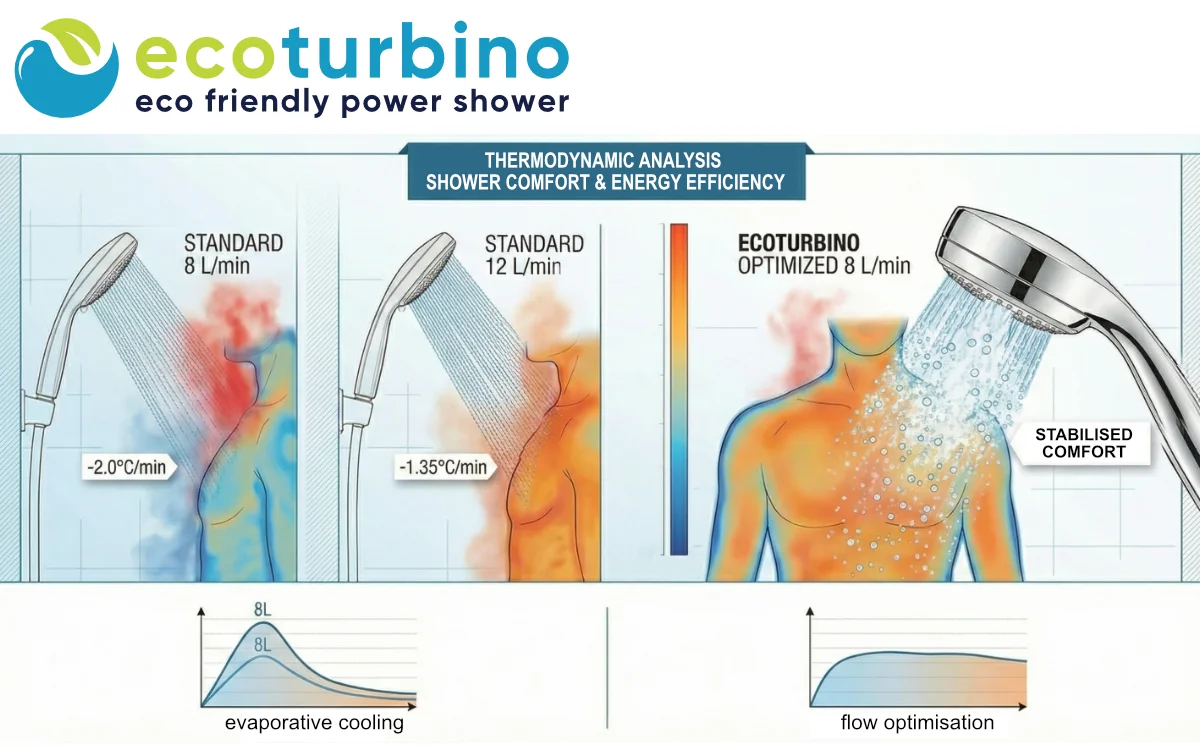
Does adding air cool down the shower water? Thermodynamics Expert Opinion: Analysis of Shower Comfort, Energy Efficiency, and the ecoturbino Shower System
Author: Ing. Werner Krenek
Expert in Applied Fluid Dynamics and Building Services Engineering
Date: 09.02.2026
To get straight to the point: Shower water is not noticeably cooled by air mixing.
Object of Investigation: Analysis of water temperature stability at varying flow rates (vs.) considering evaporative cooling and flow-optimized systems (ecoturbino).
Initial Situation and Problem Definition
In sanitary engineering practice, users occasionally report a subjective sensation of cold during the showering process, especially with reduced flow rates. The common assumption that ambient air significantly cools the water does not withstand physical scrutiny.
This expertise analyzes the actual energy transfer mechanisms and evaluates the efficiency of the ecoturbino system in compensating for thermal losses.
Thermodynamic Fundamentals
To understand the stability of water temperature, two physical quantities must be compared:
- Specific Heat Capacity (pc): Water has an exceptionally high storage capacity for thermal energy with cp ≈4.18 kJ/(kg*K). Air, on the other hand cp≈(1.0 kJ/(kg*K), possesses very low density and heat capacity.
- Heat Transfer: Heat loss through convection (release to room air) is negligible due to the short fall time of the droplets and the low thermal mass of the air. Even with a difference of 20°C between water and room air, the temperature of the jet remains nearly constant.
The Primary Factor: Evaporative Cooling (Enthalpy of Evaporation)
The decisive energy withdrawal occurs directly on the skin surface. As soon as water evaporates, it changes its state of matter from liquid to gaseous.
This process requires energy (Enthalpy of Vaporization), which is extracted from the immediate environment – namely, the water film on the skin. Influencing Factors of Evaporation:
- Surface Geometry: The finer the droplets and the more turbulent the flow, the larger the surface area available for evaporation.
- Saturation Deficit: Dry room air massively accelerates evaporation (partial pressure gradient).
Quantitative Comparison of Flow Rates
The cooling rate is directly proportional to the available water mass on the skin. A lower flow rate is more sensitive to evaporation effects:
| Parameter | Conventional | Reduced |
| Thermal Buffer Capacity | High | Lower |
| Energy Loss via Evaporation | 1.35°C/min (Base value) | 2°C/min (Increased) |
| Relative Energy Consumption | 100% | approx. 67% |
Without optimization, a reduction in flow leads to a physically measurable and subjectively noticeable cooling of the water film, as less “warm water flows in” to compensate for the energy loss of evaporation.
This results in a physical temperature difference of 0.65 K. This deviation is below the threshold of human perception and is not perceivable while showering. Standard temperature fluctuations in the supply lines (e.g., due to load changes or flow variations) are significantly higher and are considered standard operational practice.
Additionally, it should be noted that ÖNORM B 5019 for the supply line from the central unit to the shower outlet requires a maximum permissible temperature deviation of 2.5 K. The current deviation of 0.65 K is thus clearly within the normative specifications.
Mechanism of ecoturbino Technology
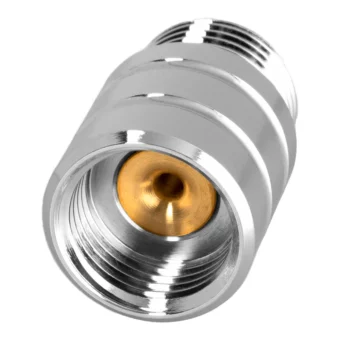
The ecoturbino system intervenes specifically in the flow dynamics to optimize the ratio between water mass and thermal perception.
- Laminar Optimization: By mixing in air (Venturi principle) and targeted turbulence, the kinetic energy of the jet is increased without needing to increase the actual amount of water.
- Reduction of Boundary Layer Evaporation: ecoturbino ensures a compact yet voluminous-feeling water jet. This optimizes the surface-to-volume ratio so that evaporation is minimized.
- Thermal Balancing: The effect is a stabilization of the skin temperature. At 7-8 L/min with ecoturbino, a level of thermal comfort is achieved that corresponds to the standard value of 12 L/min.
Summary of Results
The evaluation confirms that shower comfort is not a product of pure water volume, but of thermal stability on the epidermis.
- Comfort Guarantee: The flow optimized by ecoturbino compensates for the temperature drop that normally occurs with water-saving fittings.
- Resource Efficiency: Approximately 40-50% less water and heating energy are required to achieve the same thermal well-being.
- Physical Evidence: The system utilizes the principle of fluid dynamics to neutralize the negative effects of the enthalpy of evaporation.
The ecoturbino Advantage
ecoturbino demonstrates that shower comfort does not depend on water volume, but on thermal stability on the skin.
Through specifically optimized flow management, the temperature loss that otherwise occurs in water-saving systems is actively compensated.
The Decisive Advantage:
ecoturbino neutralizes the sensation of cold caused by evaporation -without using more water or energy.
Result:
-
Same shower comfort with 40-50% less water and heating energy
-
Physically proven compensation of evaporative cooling
-
Energy-efficient retrofitting without sacrificing comfort

Why are you overpaying 40-50% on hotel shower utility costs? Our most vital question for profit-driven hotel owners.
Why are you giving away 40-50% of your margin in your showers every day to [...]
Jan
Conclusion
ecoturbino is not a savings measure involving compromises, but a thermodynamically effective efficiency technology that combines comfort and resource conservation for the first time.