



 7-in-1 effect
 Hygiene + limescale
 Hotel water consumption
 Case studies





Blog
Greenwashing – The danger of ecological deception and the path to genuine sustainability, using ecoturbino as an example
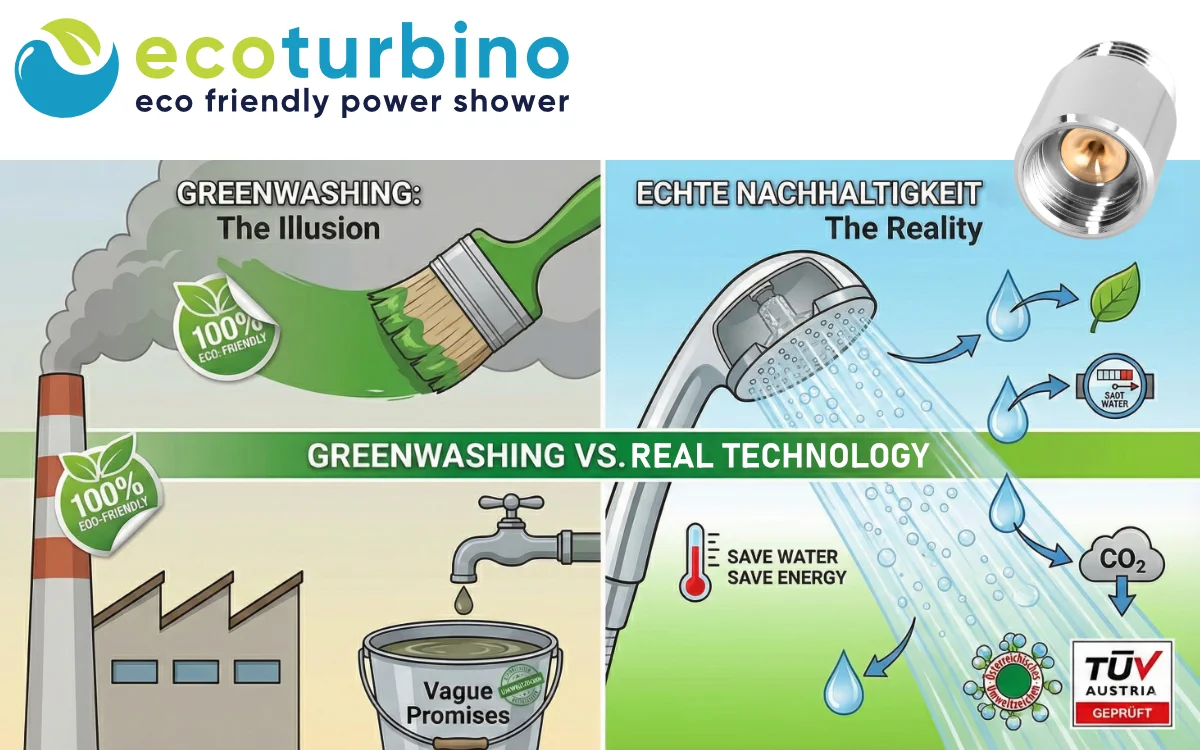
Greenwashing – The Marketing Ploy of Eco-Deception | Comparing ecoturbino for Genuine Sustainability and Systemic Change
In an era where climate change dominates the global political and economic agenda, “sustainability” has become the most critical USP (Unique Selling Proposition) of the 21st century. Consumers are increasingly willing to pay a premium for products that protect the environment.
However, this trend has a dark side: Greenwashing. While genuine eco-innovations like the ecoturbino water-saving system strive to save real resources, many companies and municipalities use a “green image” merely as a marketing facade.
This report analyzes what greenwashing is, why it represents a massive problem for our society, and why technological solutions like ecoturbino are the exact opposite of this questionable practice.
What is Greenwashing? – A Definition
According to the blog of the forestry enterprise EcoTree, greenwashing occurs whenever a company’s marketing message does not align with its actual actions.
It is the attempt to adopt a “green mantle” through targeted disinformation, obfuscation, or diversion, without making substantial ecological improvements to the core business.
Greenwashing is rarely a blatant lie. Rather, it is a subtle form of manipulation designed to steer consumer perception. Companies often use vague terms like “natural,” “conscious,” or “eco-friendly” without providing scientific evidence.
The Strategies of Greenwashing
To identify greenwashing, it helps to look at the so-called “Sins of Greenwashing”:
- Hidden Trade-offs: A product is advertised as “green” based on a single attribute (e.g., recycled content), while the rest of the production process is massively harmful to the environment.
- No Proof: Claims are made that cannot be verified by independent third parties or recognized certifications.
- Vagueness: Terms like “sustainable” are not legally protected and are often used without context.
- Irrelevance: An example is advertising “CFC-free” products, even though this substance has long been legally banned anyway.
- Lesser of Two Evils: A harmful product is presented as “better” than the competition, even though it is still destructive in its own right (e.g., “eco-friendly” cigarettes).
- False Labels: Companies invent their own “seals of quality,” which suggest trust but lack rigorous, verified criteria.
Why is Greenwashing a Problem?
Greenwashing is far more than just a harmless marketing strategy; it has severe consequences for both the environment and the economy.
Erosion of Consumer Trust
When customers repeatedly discover that “green or organic” promises are broken, trust in the entire ecological market erodes. This hits companies that act truly sustainably the hardest. If consumers can no longer distinguish what is genuine and what is not, they will likely default back to the cheapest (and often most environmentally harmful) product.
Delaying Real Climate Action
The most dangerous element of greenwashing is the illusion of progress.
When companies suggest they are already on the path to climate neutrality, the political and social pressure for real legislative regulation decreases. It creates the false impression that consumption can continue as usual, as long as the label looks right. This prevents the necessary systemic transformation of our economy.
Market Distortion
Companies that invest heavily in genuine ecological transformation-such as circular economies or carbon-neutral production-often face higher manufacturing costs. When competitors gain the same “green bonus” from customers through a cheap advertising campaign, it creates an unfair competitive disadvantage for true pioneers.
Reputable Certificates: How to Recognize Genuine Sustainability?
To avoid greenwashing, consumers and businesses must look for independent, state-recognized, or science-based certifications. Reliable labels are characterized by transparency, strict criteria, and external audits.
- Austrian Ecolabel: One of the strictest state-run seals of quality. It evaluates the entire lifecycle of a product.
- EU Ecolabel: The European counterpart that guarantees high environmental standards for products and services within the EU.
- Blue Angel: The first and oldest environmental label worldwide (Germany), which applies particularly strict ecological criteria.
- FSC/PEFC: Vital seals for sustainable forestry (though specific sub-categories must be closely monitored here).
- TÜV Certifications: Independent technical audits that often verify efficiency promises (such as CO2 savings).
ecoturbino: The Exact Opposite of Greenwashing
While many products try to appear sustainable using images of green leaves, ecoturbino is a textbook example of what experts call “Impact Technology.”
It is a water-saving system for showers, patented over 20 years ago, which demonstrates how technological innovation delivers real, measurable results without sacrificing comfort.
Transparent Technology Instead of Vague Promises
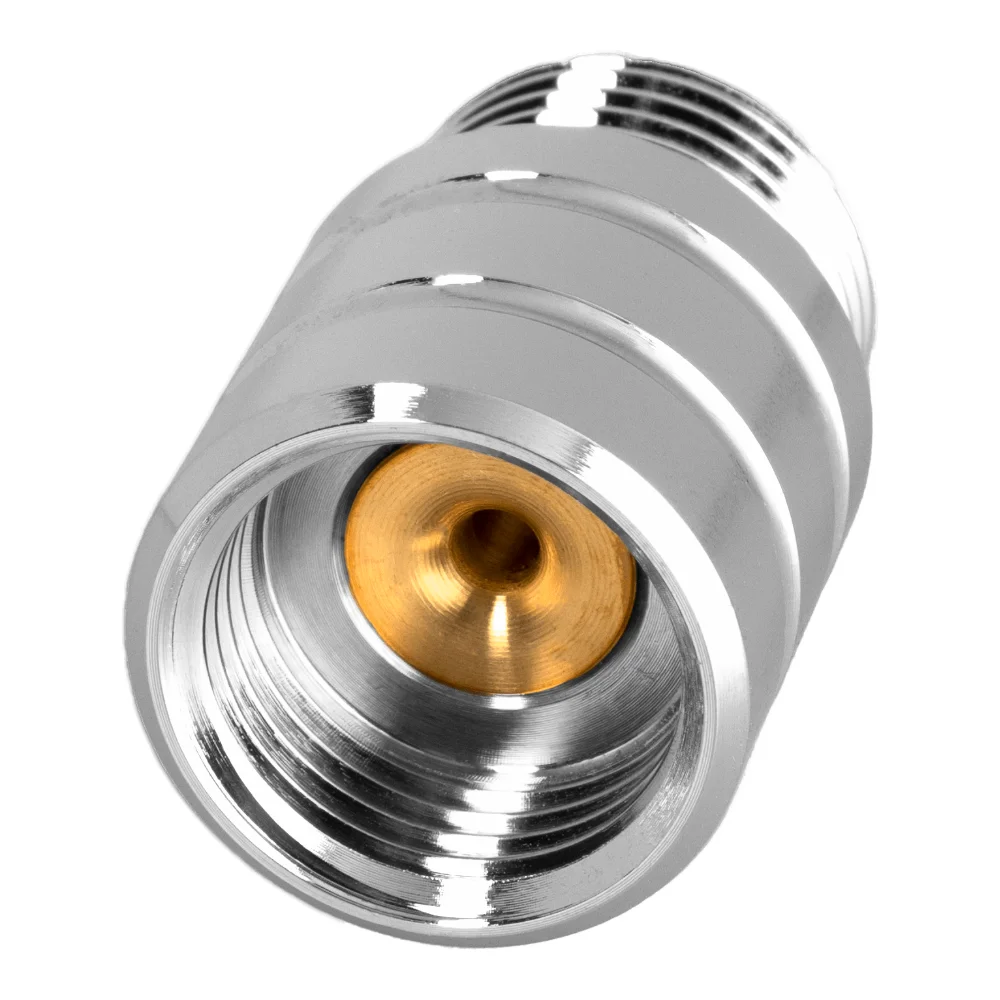
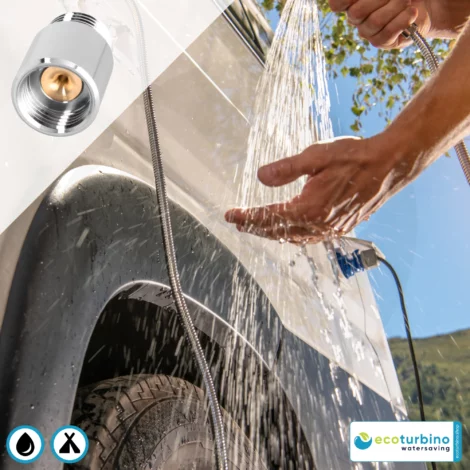
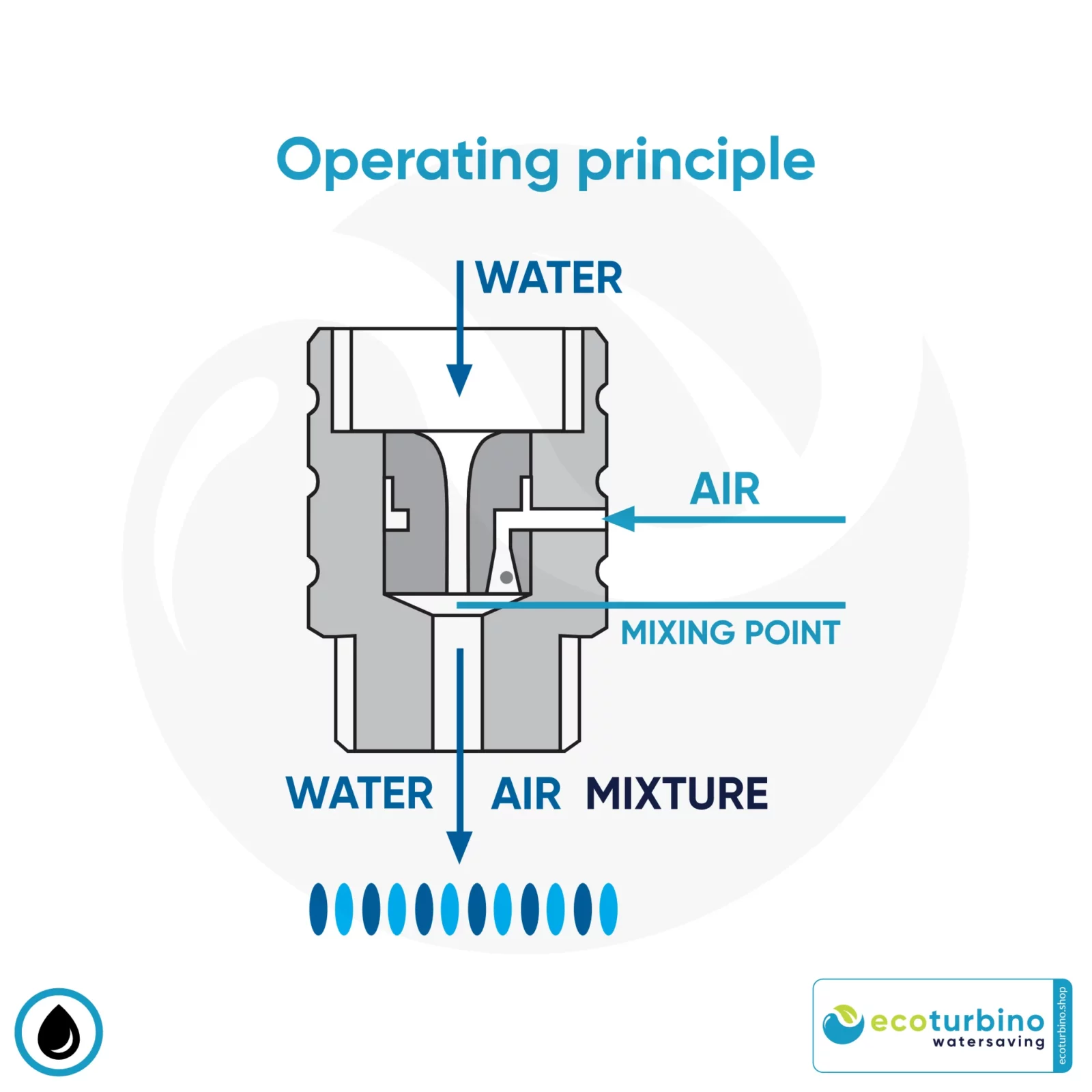
The shower adapter utilizes the Venturi principle. A specialized turbine mixes air into the water stream.
ecoturbino: “Not a limiter. An accelerator.” It is similar to a turbocharger in a car. A turbocharger does not reduce fuel consumption; it makes combustion more efficient by adding air while maintaining the same power output.
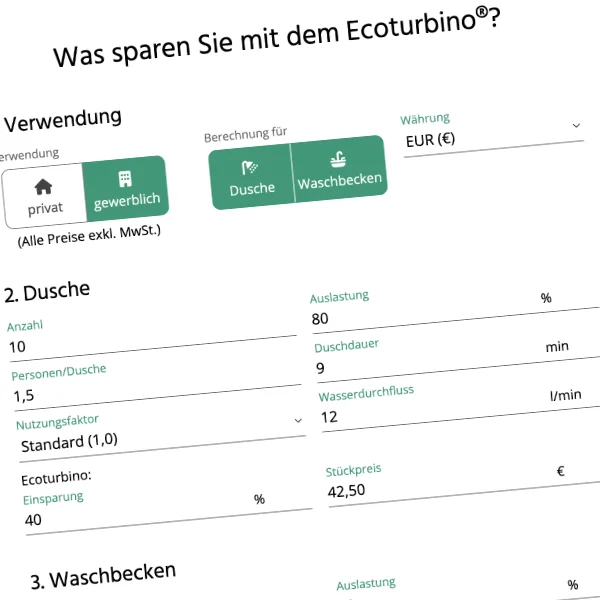
The result: Water consumption is reduced by approximately 40% to 50%, while the shower spray feels tactilely just as strong. There are no vague marketing terms here-only physically verifiable savings. We can calculate the facts and figures precisely using our Savings Calculator.
Measurable Ecological Facts
The biggest problem with greenwashing is the lack of accountability. ecoturbino, however, delivers hard data:
- Resource Conservation: An average 4-person household saves approximately 40,000 liters of drinking water per year.
- Energy & CO2: Since less water needs to be heated, the same household saves about 2,000 kWh of energy and thus around 400 to 500 kg of CO2 annually.
- Hygiene: Unlike conventional low-flow showerheads, ecoturbino prevents the formation of biofilms and reduces the risk of Legionella through high turbulence-an additional benefit confirmed by technical expert reports.
- Durability: By using high-quality metals (brass, chrome – NO ABS plastic) and offering a 10-year warranty, the product sets itself apart from the short lifespan often typical of greenwashing (adapters installed 20 years ago are still in use).
Recognized Certifications as Proof
ecoturbino does not adorn itself with invented labels; it holds high-caliber awards granted after rigorous testing procedures:
- Austrian Ecolabel: This certification officially confirms high resource efficiency and environmental compatibility.
- Energy Globe Award: One of the world’s most prestigious sustainability awards, which ecoturbino received for its contribution to energy efficiency.
- TÜV Austria Certified: The functionality and savings promises have been independently tested and verified.
Why ecoturbino is “Green-Proof”
In contrast to greenwashing projects, where sustainability is often just an “add-on,” the ecological benefit of ecoturbino is the core product itself.
The investment usually pays for itself (ROI) within a few months through saved water and energy costs. It is a win-win situation for the user and the environment, built on honesty and transparency.

Conclusion
Greenwashing is a serious threat to achieving our climate goals, as it diverts resources into ineffective marketing and undermines public trust. To counter this, we need a critical examination of claims and a reliance on reputable certificates like the Austrian Ecolabel.
Products like ecoturbino impressively show what the solution looks like: Honest technology that solves real problems, delivers measurable CO2 savings, and is validated by independent bodies.
While greenwashing attempts to save the status quo with green rhetoric, ecoturbino changes the status quo through genuine efficiency. True sustainability doesn’t need airbrushed images-it needs solutions that work.
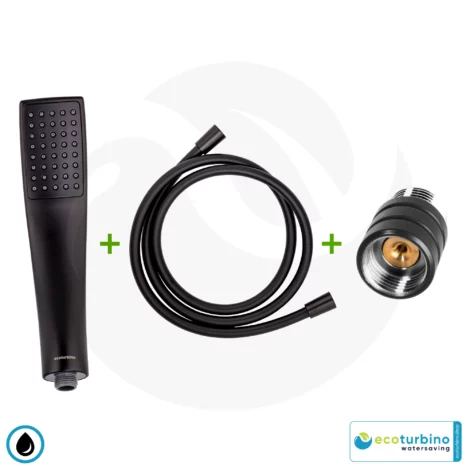
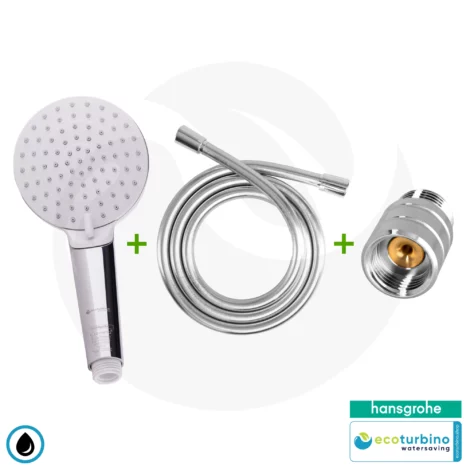
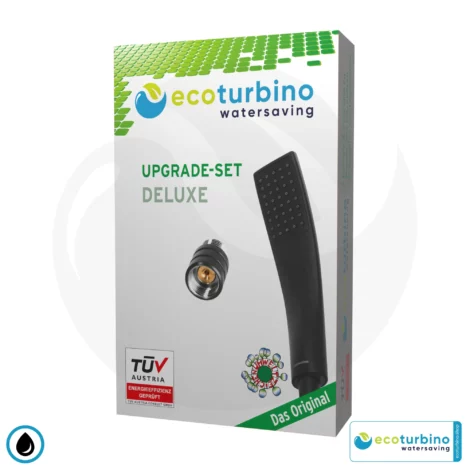
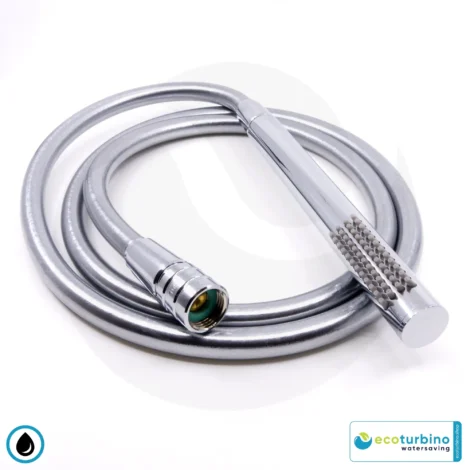
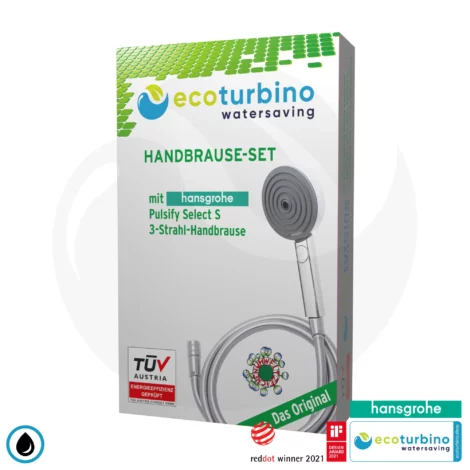
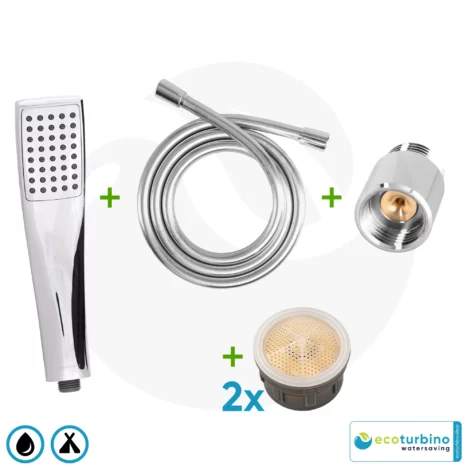
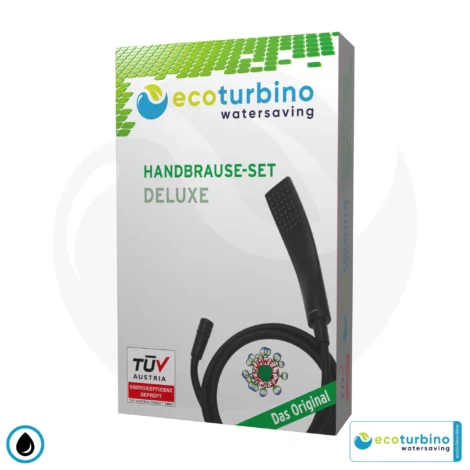
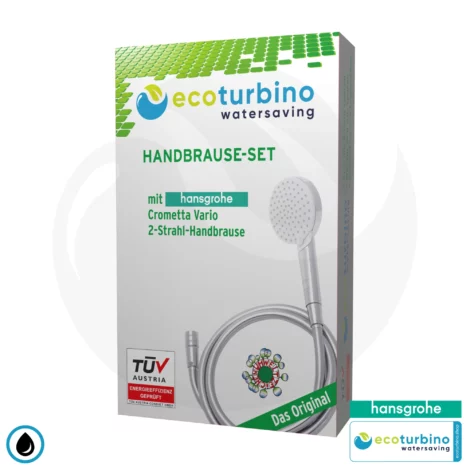
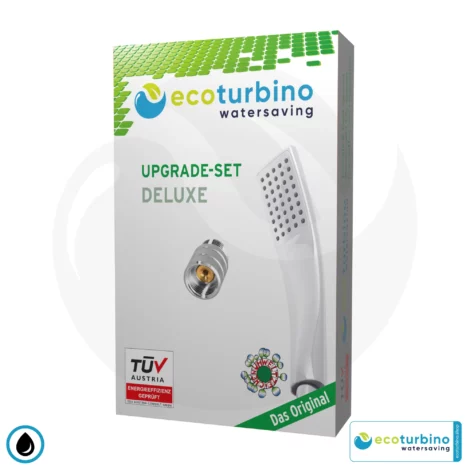
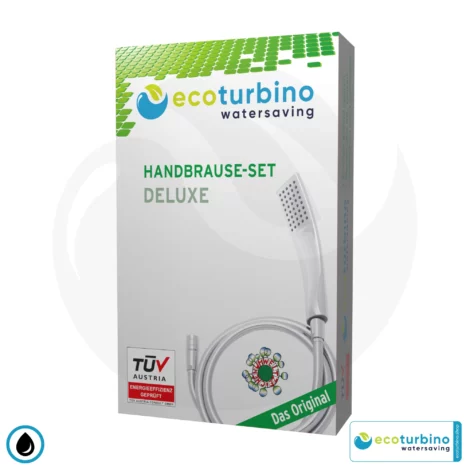
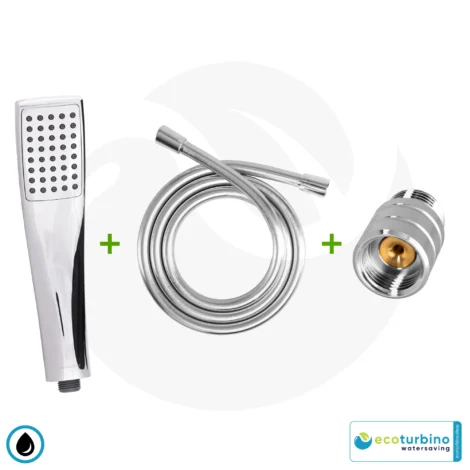
The fastest and easiest way is with our high-quality complete sets
Water saving @sets
Water saving @sets
Water saving @sets
Water saving @sets
Water saving @sets
Water saving @sets
Water saving @sets
Water saving @sets